Japanese Chess (Shogi) Network

a Gene Davis Software site

An Exciting Eastern Chess

When you capture pieces in Japanese Chess, they become yours to drop back onto the board. You can checkmate your opponent with pieces that use to be his! Even a pawn can instantly appear behind enemy lines via a drop! Having pieces switch sides makes the game very interesting.

Japanese Chess has many familiar pieces such as the King, Rook, Bishop, Knight, and Pawn. Japanese Chess also has new pieces like the Lance, Gold General, and Silver General. The board is 9x9, so it is similar in size to Western Chess boards. In Japanese Chess most pieces can promote to new pieces, not just the Pawns. If you are looking for a fresh and stimulating challenge, take a look at Japanese Chess.

Japanese Chess is also called Shogi in English. In Japanese the name is actually "Shougi" with a "u". However, the name has been shortened in English by removing the 'u'.

Shogi is a cousin to the Western Chess that most people are familiar with. Both Western Chess and Shogi are descendants of a game that came from India around 1500 years ago. Early versions of Japanese Chess appeared around 800 years ago. Modern 9x9 Shogi is much younger, being only 400 years old. If you like Chess, you will love Shogi!


Read the Rules of Shogi

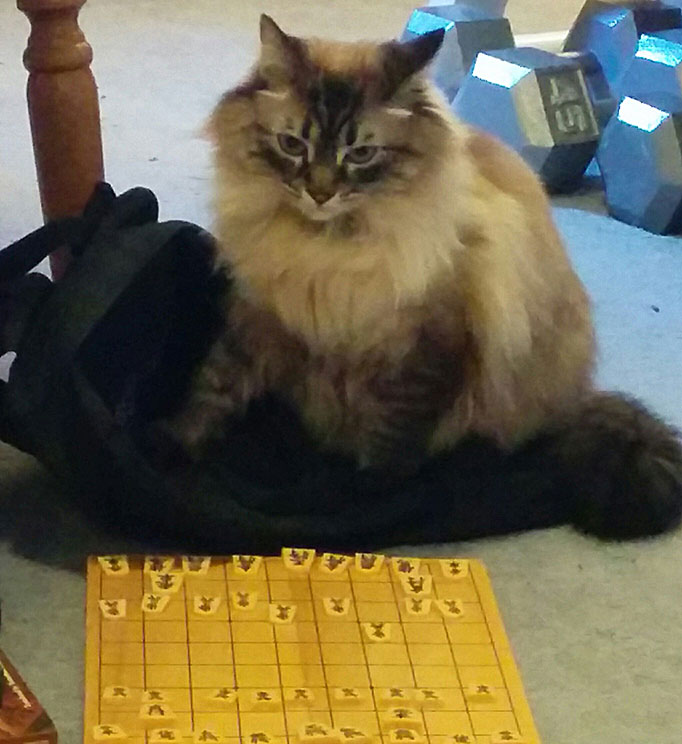
Teach them shogi while their young.

Shogi is not hard to learn. Children can learn this game and so can you. If you have ever played Chess, you have a head start, but that is not a prerequisite.

Traditionally Japanese calligraphy is used to mark the pieces in Shogi. This can intimidate westerners that can't read Japanese. Luckily there are other styles of sets out there to make life easier for the beginner. Typically, once you've learned to play, you'll want to take the time to learn the symbols the Japanese use for each piece.

I have placed the rules on my software company's site. Just click this link to read the rules of Shogi.

If you're looking for a book to teach you the rules of Shogi, buy Shogi for Beginners by Fairbairn. You won't find a better book for beginners in English.


Obtaining Shogi Boards and Pieces

Various Shogi boards

Shogi boards are a little hard to come by outside of Japan. If you're looking to find one, I would recommend checking any local Oriental/Japanese specialty stores or ask a Japanese friend where he/she would look. Another good source is Ebay. Do a search on Shogi and see what offerings are out there. There are also some sites on the web that sell Shogi boards, but I've never used them so can't give any advise about them.

Shogi boards tend to be made in Japan, for now, so are expensive imports. A good alternative is to make your own. That's the focus of this section.

English speakers are use to board games that are played on boards made with a similar process as book covers. Think about it. If you examine many board games and compare them to the cover of hard cover books you'll find they're the same.

I have never seen a Shogi board come out of Japan that was made like a book cover. Typically they are made out of a ... board. Hmm, ... imagine that.

Sometimes you'll find that Shogi boards are made out of hard plastics. Also something that is not common in English speaking countries, is that Shogi boards and pieces are simply paper. This takes a lot of getting use to by some players.

Below are links to PDFs of several styles of boards and pieces that you can print out and use to make your own Shogi board and pieces. It's a great inexpensive way to get started playing Shogi.


Shogi board (no pieces)


    A PDF of a Shogi board. That's all.


Shogi board and blank pieces


    A PDF of a Shogi board and blank pieces. This is very handy
if you have a custom design you wish to put on the pieces.


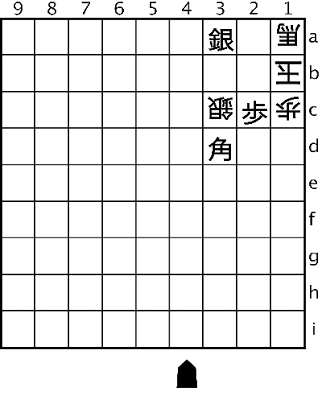
Traditional style board and pieces


    A PDF of a Shogi board and traditional kanji pieces. Promoted
pieces are red.


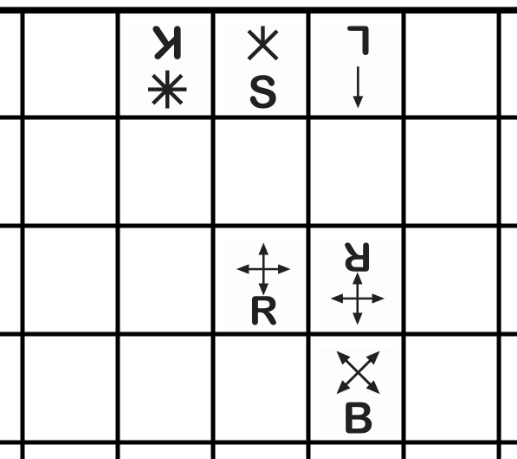
Western style board and pieces


    A PDF of a Shogi board and common western style pieces. The pieces
show a letter representing the piece and a diagram of how to move
the piece. Promoted pieces are red.


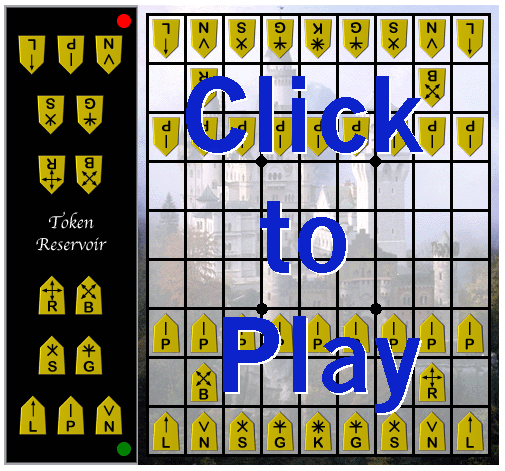
Davis style board and pieces


    A PDF of a Shogi board and a custom designed set of pieces. Icons
are used to represent the pieces.


Davis style board and pieces (black and white)


    A PDF of a Shogi board and a custom designed set of pieces. Icons
are used to represent the pieces.


Video Shogi Tutorials

You can view many wonderful Shogi tutorials on the Internet. Below is a series that I am fond of.


Lesson 1: The Board and Pieces

Setting up the board, and unpromoted piece names.


Lesson 2: Unpromoted Pieces

Movements of unpromoted pieces. I don't think he mentions, but the knight in Shogi can jump over pieces just like in Chess.


Lesson 3: Promoted Pieces

Promoted piece names and movements. Promotion Rules explained.


Lesson 4: Cool Moves

Simply how to be a cool Shogi player by handling the pieces with dexterity. This is one of my favorites. You can skip this one if you are in a hurry.


Lesson 5: The Kanji

Recognizing the Shogi kanji. There are easier versions of Shogi that do not use kanji, but eventually you will want to learn to recognize the Japanese kanji version of the pieces.


Lesson 6: Capturing and Dropping

Rules for capturing and dropping. Also, a little etiquette.


Lesson 7: Winning Shogi

Check and Checkmating rules and techniques.


More Video Lessons

Hidetchi has several more Shogi lessons on YouTube, and many other people also have video lessons on the Internet.


Portable Shogi Notation: Library and White Sheet

Portable Shogi Notation (PSN) is currently the preferred file format for preserving shogi game records outside of Japan.

Currently the Portable Shogi Notation Library project is working toward a first draft of a descriptive white sheet and a reference implementation covering current standard PSN file format specifications, standards for extending PSN to record variations of shogi, and translation from PSN to KIF format and KIF to PSN format.

After the first draft is prepared, there will be a period for open community input. There will be a "to do" list of tasks that anyone interested can contribute completed tasks from.

  • The Portable Shogi Notation white sheet is here.
  • The Portable Shogi Notation Reference Library will be here.


More Information


I have started a collection of Japanese Chess or Shogi links below. The Shogi links are unorganized at the moment. I am busy tracking down lesser know Shogi/Japanese Chess links at the moment.


 Play Shogi    


Play Japanese Chess (or Shogi) for free online.


 Buy Shogi Software    


Buy Japanese Chess / Shogi software online.


 Shogi Strategies    


Lots of Japanese Chess strategies. The best part is this shogi page has refernces mentioned so that you can check out the source for these shogi strategies.


 Professionals' Openings 2005    


A list of the professionals' openings 2005. These are not the entire matches, just the first 30 or 40 moves.
 

 CSA    


Computer Shogi Association home page. They have an annual computer shogi tournament. This has been going since 1990. Luckily they have an English version of their page.


 Yoshiharu Habu    


A nice bio of the shogi champion Yoshiharu Habu. Near the end there is an interview too.


Let me know about your link at <shogi @ my home site's domain (genedavis.com)>. Also visit my homesite at www.genedavis.com.

Play Shogi Now

Play Shogi online against your computer at japanesechess.org. Learn to play Shogi by playings against a Java applet.


Demo Samurai Chess v2

The play Shogi for free with Samurai Chess v2. Download the free version of this Shogi game from Gene Davis Software.